
November 2023 | Part 1 of our epic China trip 🇨🇳
14D13N | Shanghai → Beijing → Ningxia → Shanghai → Singapore
We missed Shanghai so much after living in China for three years that we decided to make a proper holiday out of it 😂 and this is Part 1 of our epic trip!
Can you believe we didn’t make it to Beijing in our 3 years stint? We had our flights and hotels booked but had to cancel it due to traveling restrictions when Covid became worse in early 2022.
But now, we’re finally back and Beijing is our first stop!
It was a trip filled with history, architecture, incredible food and some seriously memorable family moments. From standing on the Great Wall of China to spending four hours exploring the Forbidden City with the kids, Beijing was every bit as fascinating as I remembered it from my first visit in 2003.
Day 1 — Arrival in Beijing & Our First Peking Duck Dinner

Our Beijing adventure began with a train ride from Shanghai! We took the 11am high-speed train from Shanghai Hongqiao Railway Station to Beijing South Railway Station. The journey took about 4.5 hours, and we arrived at 3.31pm.
We made sure to book the faster service because high-speed trains on this route can take anywhere from around 4.5 to 6 hours, depending on the train. The train travelled at speeds of up to approximately 347km/h, and we were impressed by how clean the carriages were.

We also opted for first class, which had a more spacious 2+2 seating configuration. With the kids in tow, the extra room made the journey much more comfortable.
After arriving in Beijing, we took a taxi to 西西友谊酒店 (Xixi Youyi Hotel), our accommodation in 西城区 Xicheng District. The drive felt like it took forever! Beijing is a huge city, and traffic certainly didn’t help.
But there was no time to waste. We headed out to Dongcheng for what we had been looking forward to most: Peking duck!
Dinner at 全福德烤鸭店

There were plenty of famous restaurants to choose from, including 四季民福 (Siji Minfu), but we weren’t about to spend our evening queuing for dinner. We decided to try a random eatery instead — 全福德烤鸭店, a restaurant that looked the part and hoping for the best.
Oh boy, was it legit!

To be honest, we were in Beijing, the home of Peking duck. Surely, even the less famous restaurants could serve up a decent roast duck? Well, this one certainly did.

The duck was cleaned, marinated and left to dry before roasting, which helped give it that beautiful, crisp skin. It was a fabulous first dinner in Beijing.
But surprisingly, what really stole the show for me was the 炸酱面 (zhajiangmian)!

I first visited Beijing in 2003, and the zhajiangmian I had back then was quite different. I remember a strong, peanutty sesame flavour that I really didn’t enjoy. In fact, I still refuse to add sesame sauce to my hotpot dipping sauce to this day. 😂
This bowl, however, was AMAZING. The savoury sauce, noodles and accompanying vegetables came together beautifully. I honestly wasn’t expecting the noodles to be the highlight of our Peking duck dinner, but here we were!
After dinner, we walked around Dongcheng to burn off a few calories before taking a taxi back to the hotel. Along the way, we passed the Forbidden City, which was a little preview of what was waiting for us the following day!

What a way to begin our Beijing adventure!
Day 2 — Great Wall of China & Ming Tombs
八达岭长城 (Badaling Great Wall)

We set off at 7.30am in a private car for the Great Wall of China, with the journey to Badaling taking around 1.5–2 hours.
Initially, we had considered visiting another section of the Great Wall, possibly Mutianyu, which is often recommended as a less crowded alternative to Badaling. But somehow, we ended up at Badaling instead. Looking back, this was probably one of our biggest regrets of the trip!
Our driver had to stop at the base, and we couldn’t go any further by car. There were queues everywhere, and I remember wondering why on earth it was so crowded when it wasn’t even a public holiday in China.

We took the cable car up to the upper station, only to be greeted by the sight of 人山人海 — literally, a sea of people.
And I mean it. There were people everywhere!

The climb along the wall was steep, with plenty of steps to negotiate. Thankfully, it wasn’t winter yet, so the conditions were much more manageable than during my first visit in 2003, when the steps were covered in ice and climbing was genuinely difficult.
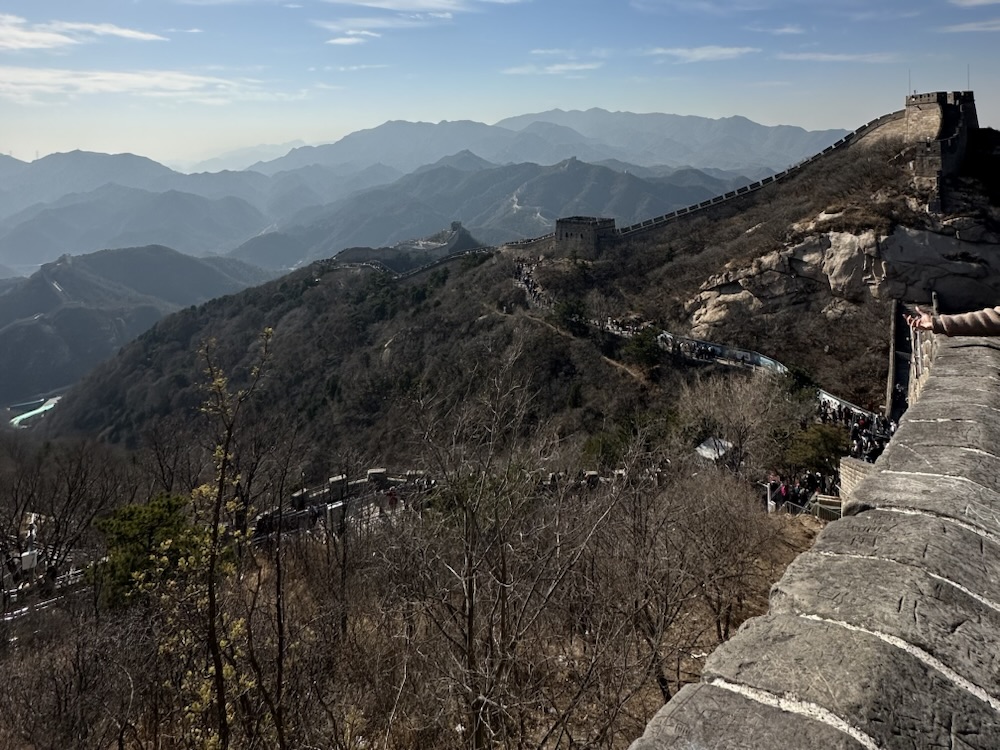
But once we reached a high point on the wall, the view was magnificent.

Despite the crowds, I couldn’t help stopping to take it all in. The wall stretched across the mountains as far as the eye could see, winding over the ridgelines like something out of a painting.

It’s one thing to read about the Great Wall in history books, but standing on it is an entirely different experience. I found myself marvelling at the sheer scale of this incredible feat of engineering and the enormous effort it must have taken to build and maintain it over the centuries.
Was it crowded? Absolutely.
Was the view worth it? Without a doubt.
Lunch — Northern Chinese Cuisine & Roast Lamb
After finally making our way out, we drove towards the Ming Tombs and stopped at a local restaurant for lunch.
And guess what we had? ROAST LAMB! 🤣

The boy absolutely loved it. He grabbed a rib and ate the meat straight off the bone, almost like eating corn off the cob. Watching him enjoy his food was a highlight in itself!
As for me, I’ll pass. Sorry, but Inner Mongolian lamb still takes the crown in my books.
明十三陵 (Ming Tombs)

Next, we visited the Ming Tombs, an imperial burial complex where 13 Ming emperors were laid to rest. The site forms part of the UNESCO-listed Imperial Tombs of the Ming and Qing Dynasties.
As someone who loves architecture, I could spend forever looking at old buildings, examining the details and imagining what life must have been like when they were first constructed.


The grounds were beautiful, spacious and remarkably clean. There was something peaceful about walking through the monumental architecture and landscaped surroundings after the chaos of the Great Wall.
We also came across a statue of Zheng He, the famous Chinese admiral and explorer whose voyages helped strengthen China’s maritime connections with Southeast Asia, including Malacca. Malacca was already an established trading port before his visits, but his expeditions played an important role in its historical relationship with China.


We then entered Dingling (定陵), the underground mausoleum of the Wanli Emperor, one of the Ming emperors buried at the site. His tomb also contained the remains of two empresses.
Descending into the underground palace felt like entering another world. The air seemed stale and the atmosphere was strangely cold. Or perhaps I was just imagining things! 🤣

A tunnel led us further into the tomb complex, where we could explore the underground chambers and get a sense of the scale of the imperial burial site.


It was fascinating to see the actual resting place of an emperor rather than just another grand palace or memorial hall.
Another Peking Duck Dinner


After a long day of sightseeing, we drove back to Beijing and returned to Dongcheng for dinner at another Peking duck restaurant, 九门轩.
The duck was pretty good, but we had to admit that we preferred the one we had the night before. 😂
Two Peking duck dinners in two days — when in Beijing, right?
By then, though, we were completely exhausted. It was time to head back to the hotel, shower and call it a night.
Day 3 — 故宫 Forbidden City & 前门 Qianmen
Exploring the Forbidden City

We arrived at the Forbidden City at around 8.30am, hoping to beat the crowds.
But who was I kidding? This is China! 😂

Nevertheless, nothing could take away from the sheer magnificence of the place. I love architecture, and the Forbidden City was practically paradise for me. Every courtyard, every roof, every doorway and every intricate detail had me stopping to stare.
We spent a full four hours exploring the Forbidden City — with the kids, no less!

What made the experience even better was having a friend who loved history lead our little tour. He shared so many fascinating stories and details that we probably wouldn’t have learnt from simply walking around on our own. And the best part? Our entire tour was in English, thanks to our Singaporean friend, who had also lived in Shanghai with his family.
Here are some of the historical details that stuck with me.
1. The animals on the rooftops were more than decoration.

Have you ever noticed the little animals lined up along the roof ridges of traditional Chinese imperial buildings?
Their number reflected the status and importance of the building. The Hall of Supreme Harmony, the grandest ceremonial hall in the Forbidden City, has ten figures — an exceptional arrangement that distinguished it from other buildings.
I love details like these. Once you know what to look for, the architecture becomes so much more interesting!
2. The Forbidden City was built by an emperor who wasn’t the original heir.

The Forbidden City was commissioned by Zhu Di, who became the Yongle Emperor of the Ming Dynasty. He was the fourth son of the Hongwu Emperor, the dynasty’s founder, and seized the throne from his nephew, the Jianwen Emperor, after a civil war.
Construction began in 1406, and the palace complex was completed in 1420. Beijing subsequently became the Ming capital.
So, it wasn’t a farmer named Zhu Di who overthrew the Yuan Dynasty. The Ming founder, Zhu Yuanzhang, was the man of humble origins who overthrew the Yuan; Zhu Di later fought his own nephew for the Ming throne.
Imagine the palace politics that must have taken place within these walls!
3. The emperor’s private quarters had their own fascinating history.

We also learnt about the changing use of the imperial living quarters. The Palace of Heavenly Purity (乾清宫) was traditionally the emperor’s main residence, but during the Qing Dynasty, the emperors increasingly used the Hall of Mental Cultivation (养心殿) as their living quarters.
There are stories surrounding Emperor Yongzheng and his succession to the throne, including rumours that he feared being assassinated after taking power. However, the idea that he moved because he was afraid of being killed by his brothers is a story to treat cautiously rather than established historical fact.
Our friend also pointed out the symbolic details of imperial decoration, including the dragon and phoenix motifs associated with imperial power. The dragon and phoenix motifs also carry symbolic meanings, with the dragon representing the emperor and the phoenix representing the empress. I remember our friend pointing out how the phoenix appeared above the dragon in Empress Dowager Cixi’s living quarters — a detail that was quite unusual given the traditional hierarchy.

And of course, there were the stone lions guarding the entrances.


The traditional pairing has the male lion holding a ball under its paw and the female lion tending to a cub. One represents authority and protection, while the other symbolises nurturing and continuity.

Four hours later, we finally exited through the northern gate.
Our friend suggested visiting Jingshan Park (景山公园), just across the road, where we could climb the hill for a panoramic view of the Forbidden City.
Historically, this hill is also associated with the tragic end of the Ming Dynasty. In 1644, the last Ming emperor, the Chongzhen Emperor, reportedly hanged himself on the hill as rebel forces entered Beijing. Accounts also record that he killed members of the imperial household before his death.
Was I interested in climbing the hill after four hours of walking?
NO THANKS, MAN. My legs were DEAD. 😱🤣
Lunch — Qianmen 前门

We headed to the traditional food streets around Qianmen for a simple lunch of Beijing snacks.
Think baozi, jianbing and grilled skewers — nothing fancy, just the sort of casual local food that makes exploring a city so enjoyable.

After lunch, we returned to the hotel for a much-needed rest before heading out again.
Dinner — 很久以前 (Hen Jiu Yi Qian)

For dinner, we found 很久以前 (Hen Jiu Yi Qian) in a shopping mall near our hotel.
If you’ve been to Shanghai, you’ll know how crazy the queues at popular restaurants can get. So imagine our surprise when we found this place in Beijing and it wasn’t even crowded at around 7pm!

We were more than happy to enjoy our meal without a long wait. After a full day of history, walking and sightseeing, that was exactly what we needed.
Then it was back to the hotel for another well-deserved rest.
Day 4 — 恭王府 Prince Gong’s Mansion & 什刹海 Shichahai
Prince Gong’s Mansion

We started our day early again, arriving at Prince Gong’s Mansion (恭王府) at around 9am.
If the Forbidden City showed us the grandeur of imperial power, Prince Gong’s Mansion offered a glimpse into the private world of Qing Dynasty nobility.

The mansion was originally built in 1777 for Heshen, a powerful court official who served under the Qianlong Emperor. He became enormously wealthy and was later accused of corruption by the Jiaqing Emperor, who ordered his execution and confiscated his property.

The estate subsequently passed through other hands before becoming the residence of Prince Gong, after whom it is named.
What makes the mansion so fascinating is its combination of traditional courtyard residences, ornate halls and beautiful gardens. The complex reflects the lifestyle of the Qing aristocracy, with carefully designed spaces for both daily living and entertaining guests.
As someone who loves architecture, I was in my element again!

I could spend hours examining the courtyards, decorative details, pavilions and garden features. There’s something special about visiting places like these because you’re not just looking at buildings — you’re getting a glimpse into how people lived centuries ago.
Lunch & an Afternoon Stroll — Shichahai

After exploring the mansion, we headed to the Shichahai (什刹海) area for lunch.
This was such a lovely change of pace from the monumental palaces and busy tourist attractions we had visited over the past few days.

Shichahai is a historic waterside neighbourhood comprising three connected lakes: Qianhai, Houhai and Xihai. The area is known for its lakeside scenery, willow trees, traditional hutongs and old courtyard houses.
We enjoyed the relaxed atmosphere, with the water, greenery and traditional Beijing neighbourhoods all around us. It was a lovely place to slow down and take in a different side of the city.
I particularly enjoyed seeing how the historic architecture blended into everyday life. Unlike the Forbidden City, which was built to project imperial power, the hutongs and lakeside streets felt much more intimate and lived-in.

If you enjoy architecture, history and leisurely walks, I’d definitely recommend setting aside some time for this area.
Dinner — Hotpot & Our Last Evening in Beijing

We had an early dinner at a famous hotpot restaurant before taking a walk around the area.
Unfortunately, I didn’t record the restaurant’s name in my notes, so I can’t confidently identify it now. But hotpot was a fitting way to end our Beijing stay, especially with the cold weather setting in.
After several days of walking, exploring historic sites and eating our way around the city, we decided to have an early night.
We had an early flight the next morning, and our next destination was somewhere completely different from Beijing’s imperial palaces and busy city streets.
We were heading to Ningxia!
Day 5 — From Beijing to Ningxia ✈️

It was time to leave Beijing and continue our epic China adventure.
We flew from Beijing to Yinchuan (银川), the capital of Ningxia Hui Autonomous Region, for the next four nights of our trip.
After four days of imperial history, the Great Wall, traditional architecture and Peking duck, we were ready for a completely different experience — one filled with dramatic landscapes, Hui culture and the distinctive scenery of north-western China.
And this was only the middle of our journey!
From Singapore to Shanghai, then Beijing, Ningxia and back to Shanghai before finally returning home, this November 2023 trip turned into so much more than a simple holiday.
We had missed Shanghai terribly after our three years living in China, and this was our way of revisiting a place we loved while exploring parts of the country we hadn’t experienced together as a family.
Beijing was exhausting at times, especially with all the walking, but it was also an unforgettable reminder of just how much history and culture China has to offer.
Next stop: Ningxia, where our adventure continues! 🇨🇳

Leave a Reply